
Why Is Water Pooling in My Yard After It Rains? Common Causes in Whatcom County
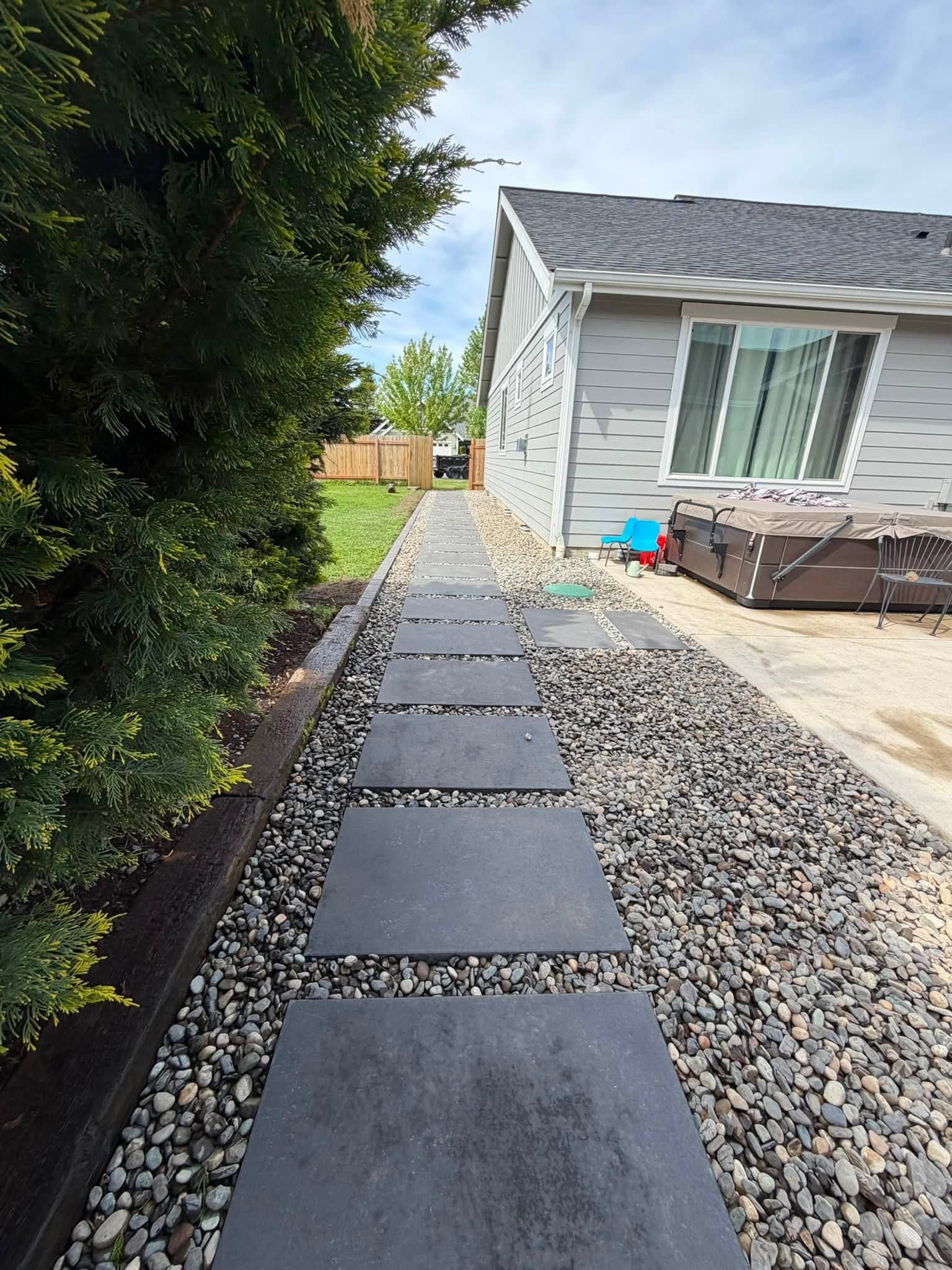
If your yard is holding onto puddles for days after a Whatcom County rain, you’re dealing with one of the most common issues homeowners around here run into. Between our steady rainfall, a mix of denser clay soils and sloped properties, and neighborhoods that range from tight in-town lots in Bellingham to larger acreage near Lynden and Everson, standing water shows up for a handful of predictable reasons.
The good news is that pooling water almost always has an identifiable cause, and in most cases, a fixable one. Here’s what’s usually behind it and what actually helps.
Quick Answer: Standing water in a Whatcom County yard is usually caused by compacted or clay-heavy soil, poor grading that directs water toward the house instead of away from it, or a low spot with nowhere for water to drain.
With Whatcom County’s consistent year-round rainfall and mix of low-lying and sloped properties, these issues show up often from Bellingham to Ferndale to Lynden. Fixes range from regrading the yard to installing a French drain, a catch basin, or a retaining wall with built-in drainage, depending on the cause. Get a free drainage assessment→
Common Causes of Water Pooling in Whatcom County Yards
1. Compacted or Clay-Heavy Soil
Much of Whatcom County sits on dense soil that doesn’t drain quickly to begin with, and years of foot traffic, construction, or heavy equipment can compact it further. Once soil is compacted, rain has nowhere to go but sit on top of it.
2. Poor Yard Grading
If your yard slopes toward your house, a fence line, or a low corner instead of away from it, water will collect there after every rain. This is a common issue on older lots around Bellingham and Ferndale, where original grading was never properly established or has shifted over time.
3. Low Spots and Depressions
Even a yard that’s graded reasonably well can have one low area, sometimes just a few inches lower than everything around it, where water consistently pools. These spots tend to get worse over time as saturated soil continues to settle.
4. Consistent Year-Round Rainfall
Whatcom County gets steady rain across most of the year, which means the ground rarely has a long stretch to fully dry out between storms. Soil that’s already saturated has less capacity to absorb the next round of rain, making pooling more likely with each storm.
5. Blocked or Missing Drainage Systems
Some properties already have a drainage system in place, whether that’s a French drain, a catch basin, or a simple swale, but it’s become blocked by sediment, roots, or debris and stopped doing its job. Other properties just never had a drainage system installed.
6. Downspouts Draining Too Close to the House or Yard
When gutters empty out just a foot or two from the foundation instead of being routed further away, that water often pools in the surrounding lawn or flows back toward the house.
What Actually Fixes Yard Drainage Problems
The right fix depends on the cause, but here are the solutions that address most Whatcom County drainage issues:
French Drains
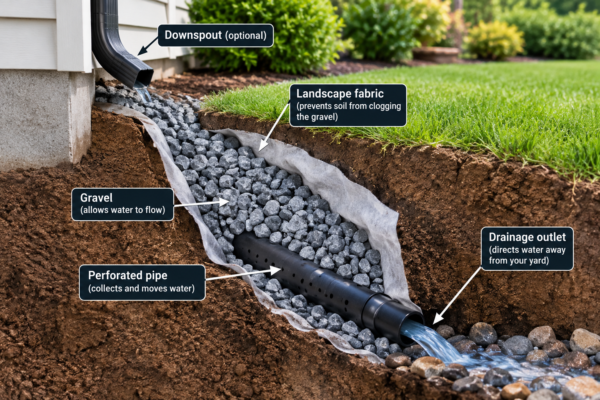
A French drain is a trench dug along the problem area and lined with gravel, with a perforated pipe running through the middle that’s wrapped in fabric to keep soil and sediment from clogging it over time. Water seeps down through the gravel into the pipe and is carried away to a lower point on the property, a ditch, or the street, instead of sitting on the surface. This works especially well for low spots, compacted soil, and areas where water consistently collects along a fence line or foundation.
Catch Basins
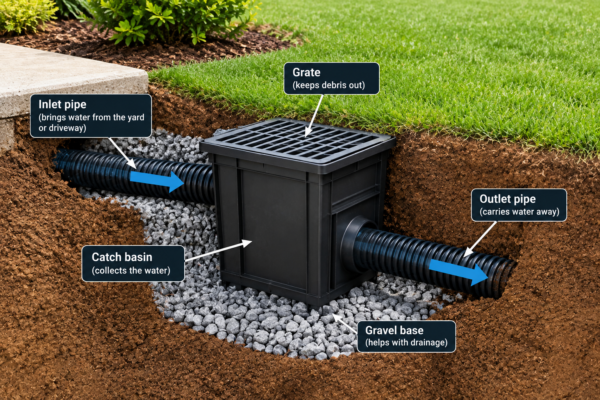
catch basin is a small underground box, usually fitted with a grated lid, that sits at the lowest point in the yard where surface water naturally collects. Water flows into the grate and down into the basin, which connects to underground pipe that carries it away from the house or lawn.
Catch basins are frequently paired with a French drain, so water gets captured right at the trouble spot and then carried the rest of the way through the drain line.
Regrading
Regrading involves adding, removing, or reshaping soil across the yard to reestablish a gentle slope that carries water away from the house and toward a spot where it can drain naturally, rather than settling wherever the existing slope happens to direct it. It’s often done in combination with a French drain or catch basin, especially when a single low spot can’t be graded away entirely.
Retaining Walls with Drainage Systems
A retaining wall built for drainage is typically constructed from interlocking concrete blocks or boulders, with gravel backfill placed behind the wall and a perforated drain pipe running along its base. The gravel lets water move freely down to the pipe instead of building up pressure behind the wall, and the pipe carries that water out to a safe discharge point. This is especially useful on sloped properties, which are common in parts of Whatcom County outside Bellingham’s flatter neighborhoods, where water would otherwise pool at the base of the slope.
Rock Walls
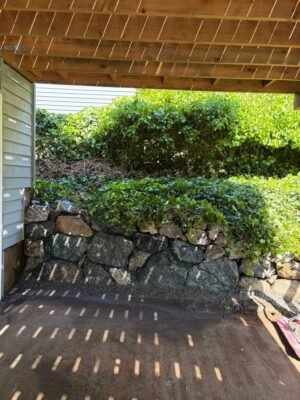
Rock walls are built from stacked natural stone or boulders and can be constructed with the same gravel backfill and drainage principles as a block retaining wall. They serve a similar drainage purpose while giving a more natural, less formal look, and are also useful for controlling erosion on a slope in addition to managing water flow.
Often, the most effective fix is a combination, for example, a catch basin at a low point connected to a French drain that carries the water the rest of the way off the property. That’s why an on-site assessment matters more than guessing based on symptoms alone.
When to Get a Drainage Assessment
If you’re seeing any of the following, it’s worth getting your yard looked at:
Not sure what’s causing the pooling in your yard? Get a free on-site drainage assessment from our Whatcom County team — we’ll walk your property, identify the actual cause, and recommend the right fix, whether that’s a French drain, a catch basin, regrading, or a retaining wall.
Find The Solution Today
Standing water isn’t just an inconvenience — left alone, it can lead to foundation issues, dead patches in the lawn, and worse drainage problems over time. If you’re dealing with pooling water on a property in Bellingham, Ferndale, Blaine, Lynden, or anywhere else in Whatcom County, contact us today for a free drainage consultation. We install French drains and catch basins, regrade yards, and build retaining and rock walls with proper drainage throughout Whatcom County.
Or text/Call Us at