
Curved Paver Walkway, Drainage Fix, and River Rock Beds in Mount Vernon, WA
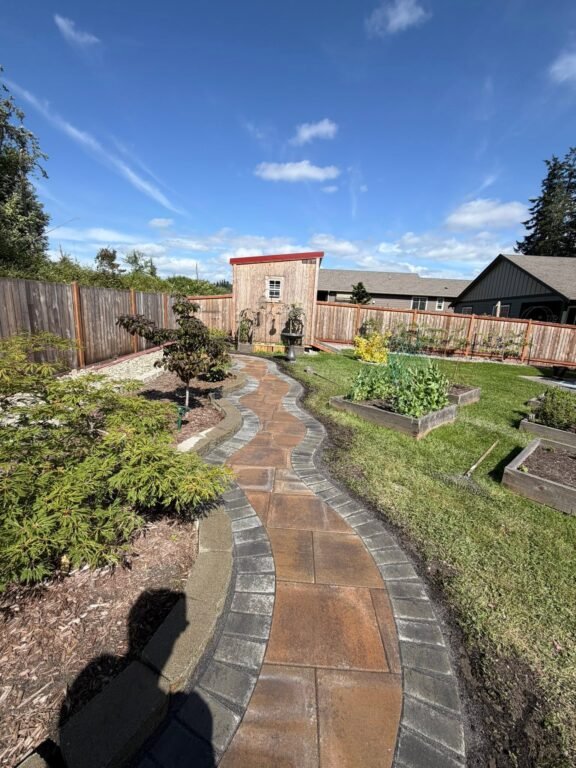
10-12-2026 – Brownstone L&H LLC
Curved Paver Walkway, Drainage Fix, and River Rock Beds in Mount Vernon, WA
A returning client near Little Mountain in Mount Vernon, WA called us about water pooling in their yard. We fixed the drainage, built an 80-foot curved paver walkway to reach their planters, and replaced high-maintenance bed areas with river rock, all in 4 to 5 working days.
1) Project at a glance
– Location: Off Laventure Road near Little Mountain, Mount Vernon, Skagit County, WA
– Scope: Curved paver walkway, two catch basins, and two river rock beds
– Walkway: About 4 feet wide and 80 feet long, curved
– Pavers: Belgard Mega-Lafitt in Autumn, random three-piece pattern, with a charcoal border
– Base: Open-grade rock over geotextile fabric
– Drainage: Two catch basins connected to the existing drain line
– Beds: One bed of 2 to 4 inch cobble, one of half-inch river rock, both over weed barrier with a block border
– Site: Sloped yard with clay soil
– Timeline: 4 to 5 working days
– Typical cost for a similar project: $10,000 to $30,000
2) What the homeowner needed
This was a repeat client. They had worked with us before and called us back with three things they wanted fixed:
– Water pooling. Rain was collecting in the yard instead of draining away.
– Better access. They wanted more hardscape so they could walk to their existing planters without crossing wet ground.
– Less maintenance. The planter bed areas took constant weeding and upkeep.
No formal design was needed for this one. We laid the walkway out to follow the natural grade of the property, which let the hardscape and the drainage work together.
What we built
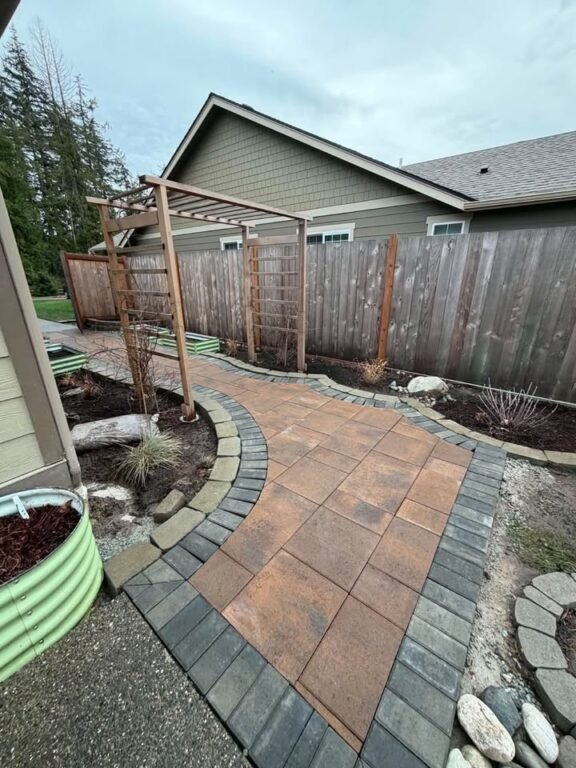
1) Curved paver walkway
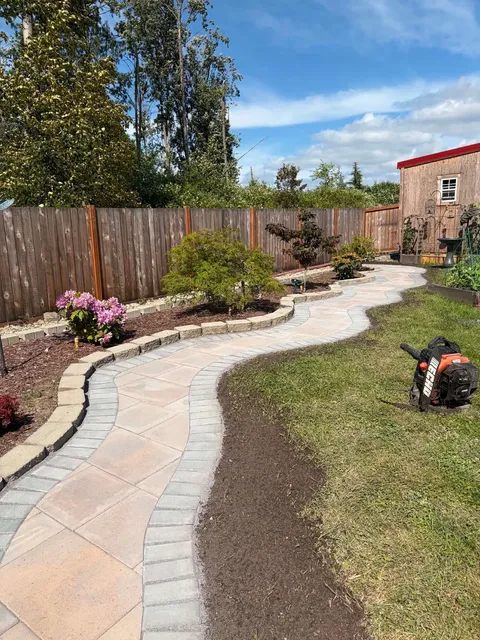
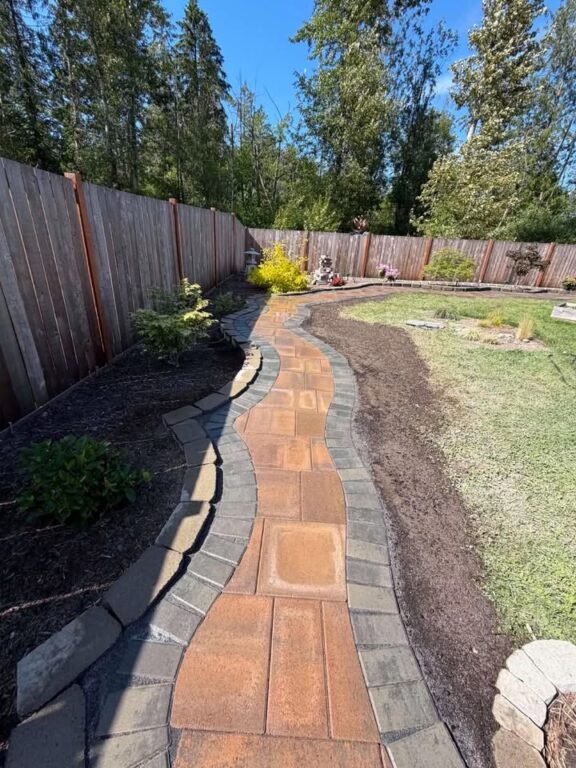
The walkway runs about 80 feet and is 4 feet wide, wide enough to walk side by side or push a wheelbarrow to the planters. We used Belgard Mega-Lafitt pavers in the Autumn color, laid in a random three-piece pattern. The larger slab-style pieces and the random layout give it a natural stone look, and the warm color ties in with the planting.
A charcoal border runs the full length on both sides. It frames the curves and gives the walkway a clean, finished edge.
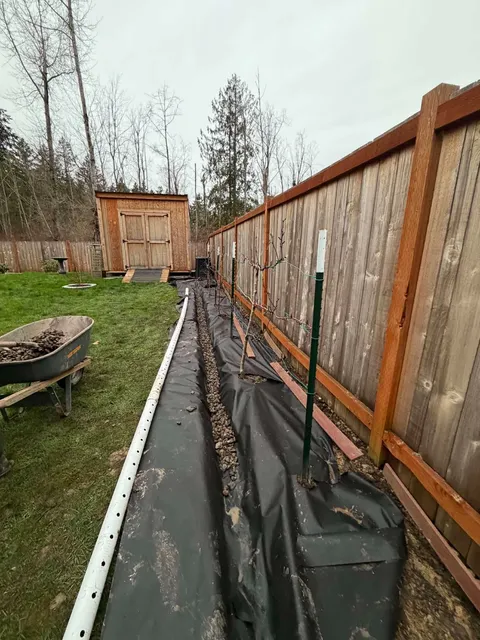
2) Drainage with two catch basins
The property already had a drain line, but water had no good way to reach it. We installed two catch basins at the low points and connected them to the existing pipe. Surface water now collects in the basins and leaves the yard instead of pooling.
Using the existing line kept the cost down, since the work was the connections and the basin boxes rather than a new pipe run.
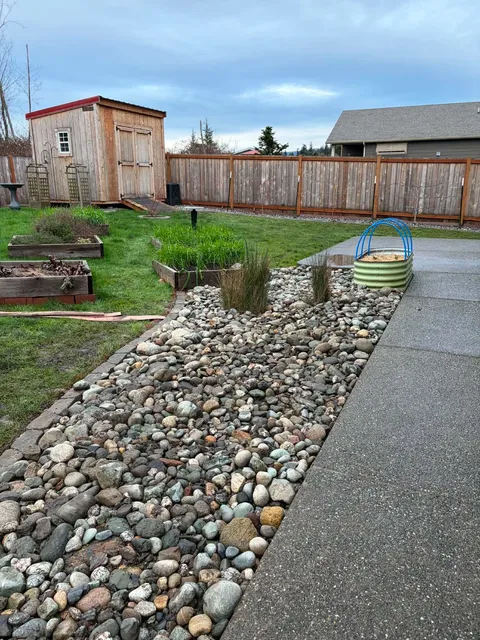
3) River rock beds
We replaced two high-maintenance bed areas with rock:
Bed one: 2 to 4 inch cobble rock, for a bolder look and texture.
Bed two: Half-inch river rock, for a finer finish.
Both beds sit on weed barrier fabric and are framed with border block, so the rock stays in place and weeds have a hard time getting started.
How we built it
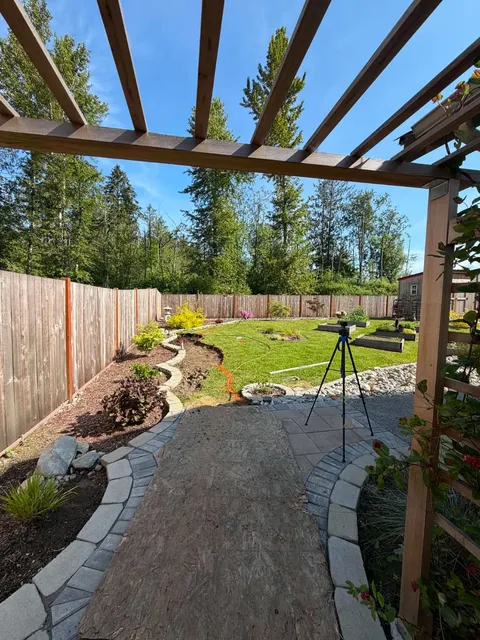
Excavation
We removed 8 to 10 inches of soil along the full walkway and bed areas. Digging out the soft topsoil and clay makes room for a proper base, so the walkway sits on rock instead of on ground that holds water.
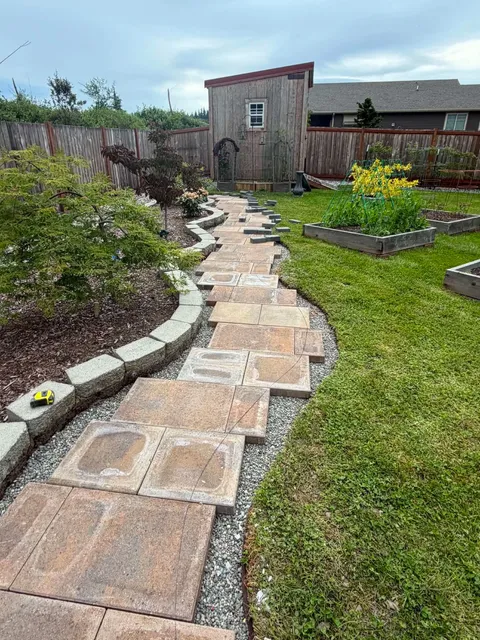
Laying out the curves
We used PVC pipe to lay out the curves on the ground, adjusting it until the lines flowed the way we wanted. Then we marked the shape before any cutting. PVC bends into a smooth, even arc, which is much harder to get by eye.
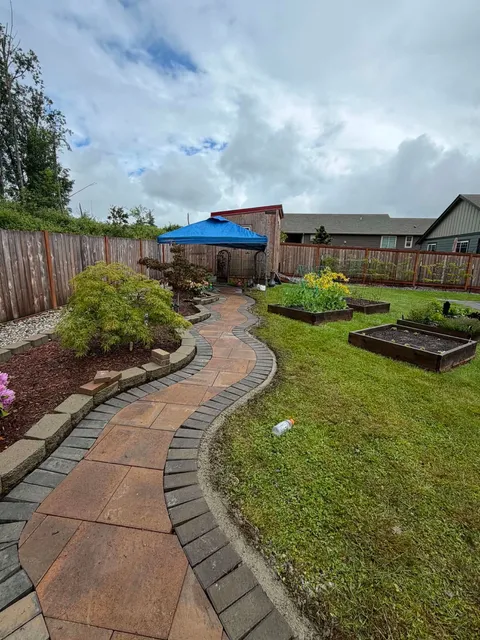
A full day of cutting
Curved walkways take far more cutting than straight ones. Every paver along each edge has to be cut to follow the arc and meet the border cleanly. We spent a full day on cuts alone. Rushing this step leaves gaps and uneven lines that show for the life of the walkway.
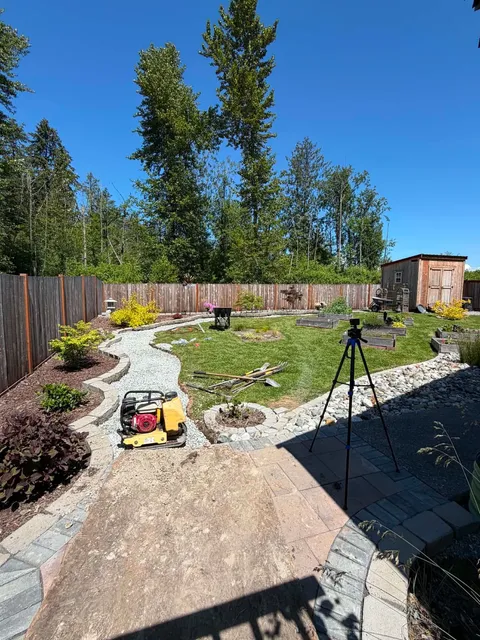
Open-grade base over fabric
The walkway sits on the same base we use on every project: geotextile fabric over the native soil, then an open-grade base of clean crushed rock. Water drains straight through it instead of sitting in it.
That mattered even more here because of the clay. Clay holds water, and a base that stays wet shifts over time. The fabric keeps the clay from working up into the rock, and the open-grade base lets water move out.
Working with the slope
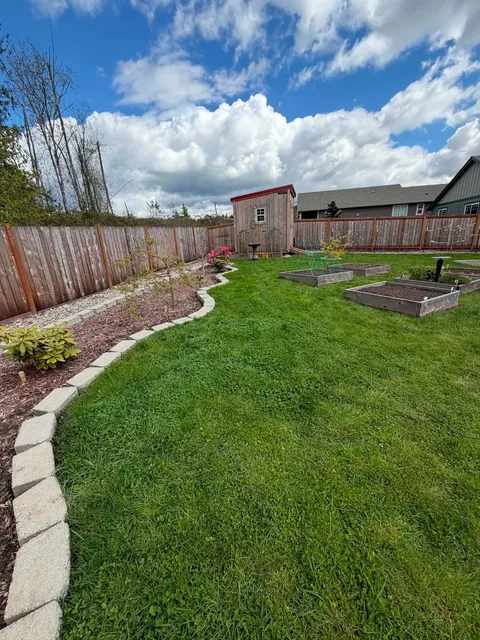
The yard sloped, so we set the pitch of the walkway to carry water toward the catch basins instead of across the path. We adjusted the height of the catch basin boxes to match the finished grade, so water flows in naturally and the basins sit flush with the surface.
Polymeric sand
With the pavers and border set and compacted, we swept Gator Maxx polymeric sand into the joints and watered it in. Once it hardens, it locks the pavers together and helps keep weeds and ants out of the joints.
Final cleanup
We finished with a full cleanup of the site: excess sand blown off the pavers, the walkway and beds cleaned, and the work areas cleared. Then we walked the finished project with the homeowner.
How long it took
The full project took 4 to 5 working days from start to finish. That included layout, excavation, fabric and base, the catch basin connections, a full day of cutting for the curves, paver installation, and both river rock beds.
What a project like this costs
A project like this one, with a paver walkway, drainage, and rock beds, typically ranges from $10,000 to $30,000 depending on the scope of work and the materials. Adding lighting, higher-end pavers, or more features can bring it to $20,000 to $50,000.
The main things that move the price:
Walkway length and width
– Curves. Curved walkways take more cutting and labor than straight ones.
– Paver choice. Larger slab-style and premium pavers cost more.
– Drainage. Tying into an existing line costs less than running new pipe.
– Slope and soil. Grade changes and clay need more base work.
– Extras such as lighting, steps, or more beds
Common questions about projects like this
How much does a paver walkway cost in Mount Vernon?
A paver walkway with drainage and rock beds like this one typically ranges from $10,000 to $30,000. Lighting, premium pavers, or added features can bring it to $20,000 to $50,000.
Do curved paver walkways cost more than straight ones?
Yes. Every edge paver has to be cut to follow the curve, which adds labor. On this project, cutting alone took a full day.
How do you fix water pooling in a yard?
It starts with finding where the water collects and where it can go. Here, we added catch basins at the low points and tied them into an existing drain line, then pitched the walkway to send water toward them.
Can you build a paver walkway on clay soil?
Yes, with the right base. Geotextile fabric keeps the clay out of the rock, and an open-grade base drains water instead of holding it, which keeps the pavers from shifting.
Is river rock lower maintenance than mulch?
In most cases, yes. River rock over weed barrier does not break down or need replacing every year the way mulch does, and a border block keeps it in place.
Dealing with water pooling or planning a walkway in Skagit County?
If water is pooling in your yard or you want a walkway that holds up to our rain, we would be glad to take a look. Many of our projects, like this one, solve a drainage problem and add usable space at the same time.
Brownstone L&H builds paver walkways, patios, drainage systems, and low-maintenance landscapes in Mount Vernon, Burlington, Sedro-Woolley, Anacortes, and throughout Skagit, Whatcom, and Snohomish County. Call (360) 333-7738 or request a free estimate.
License Number
#BROWNL*753BW
Phone
360-333-7738
Brownstonelh@gmail.com