Brownstone L&H llc
Pavers vs. Concrete Patio: Which Is Better in the Pacific Northwest?
10-7-2026 – Brownstone L&H LLC
Pavers vs. Concrete Patio: Which Is Better in the Pacific Northwest?
Pavers cost more up front and last longer with easier repairs. Poured concrete costs less on day one and gives a clean, simple look, but it will crack eventually and those cracks are hard to hide. Which one is right depends on your budget, your soil, and how long you plan to stay in the home.
At Brownstone L&H we build patios, walkways, and driveways across Skagit, Snohomish, and Whatcom County. This is the comparison we walk homeowners through before they decide: what goes under each surface, what each is made of, how long they last in our wet climate, and what they really cost.
Pavers vs. concrete at a glance
– Installed cost: Pavers cost more. Plain concrete costs less, and stamped concrete is about the same as pavers.
– Typical lifespan: Pavers last 30 to 50 years or more. Concrete lasts 25 to 30 years.
– Cracking: Paver joints flex, so the surface does not crack. Concrete cracks over time, even with control joints.
– Repairs: Pavers are lifted and relaid, and the repair is invisible. Concrete is patched or replaced, and patches show.
– Ready to use: Pavers are ready the day they are finished. Concrete needs 1 to 2 days for foot traffic and about a week for vehicles.
– Maintenance: Pavers need joint sand topped up every few years. Concrete needs resealing every 2 to 3 years. Both need washing.
– Traction when wet: Pavers grip well thanks to texture and joints. Broom-finish concrete grips well too, but sealed stamped concrete can be slick.
– Design options: Pavers come in many colors, shapes, patterns, and borders. Concrete can be plain, colored, exposed aggregate, or stamped.
– Drainage: Pavers come in standard or permeable options. Concrete is a solid surface that relies on slope.
The base: what goes underneath
The base decides how long either surface lasts. Most failed patios we are called to fix, paver or concrete, failed from the ground up.
Paver base
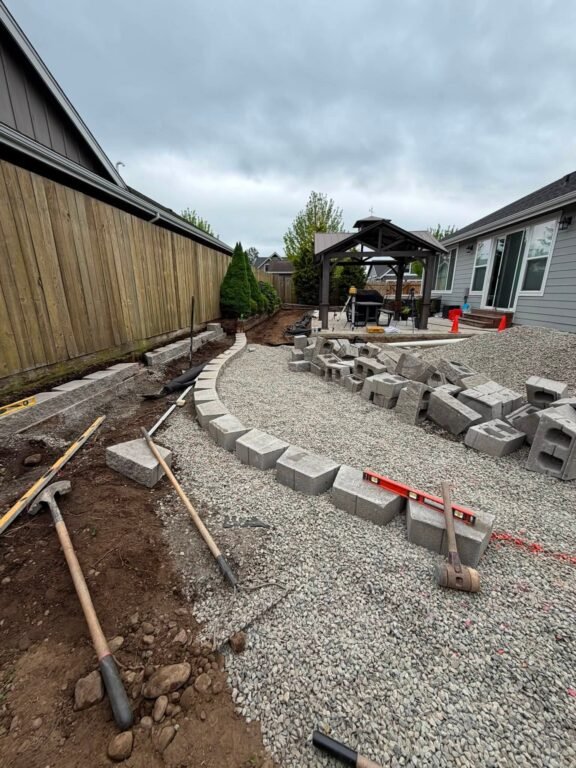
A paver patio is built in layers:
1. Excavation of about 7 to 9 inches for a patio, deeper for a driveway.
2. Geotextile fabric over the native soil. This matters in our area because clay and wet soil will pump up into the rock without it.
3. Compacted crushed rock, 4 to 6 inches for patios and walkways and 8 to 12 inches for driveways, compacted in lifts.
4. Bedding layer of about 1 inch of sand or fine crushed rock, screeded flat.
5. Pavers, set in pattern and compacted into the bedding.
6. Edge restraint around the perimeter so nothing spreads.
7. Polymeric sand swept into the joints and activated with water to lock everything together.
Concrete base
A concrete slab needs less depth but the same care:
1. Excavation of about 8 inches.
2. Compacted gravel base of about 4 inches for drainage and support.
3. Forms and reinforcement, either rebar or wire mesh.
The pour, typically 4 inches thick for patios and 5 to 6 inches for driveways.
4. Finish and control joints, cut to guide where the slab cracks.
5. Curing. Concrete reaches full strength in about 28 days.
Both surfaces need a slope of about 1/4 inch per foot away from the house so rain runs off. With the amount of rain we get, a flat patio becomes a puddle.
The material: what you are standing on
Concrete pavers are made in a factory under pressure and are rated at about 8,000 psi. Poured residential concrete is usually 3,000 to 4,000 psi. Individual pavers are denser and stronger than a poured slab.
The bigger difference is how each handles movement. The ground here shifts as it goes from saturated in winter to dry in summer, and tree roots push from below. A paver surface is hundreds of small units with sand joints, so it flexes with that movement. A concrete slab is one rigid piece, so it resists until it cracks.
For looks, pavers come in a wide range of colors, sizes, and textures, and you can add borders and patterns. Concrete can be left plain, colored, finished with exposed aggregate, or stamped to imitate stone.
Longevity and repairs
A properly built paver patio lasts 30 to 50 years or more. A concrete slab typically lasts 25 to 30 years before cracking, surface wear, or settling makes replacement worth considering.
Repairs are where the two differ most:
– Pavers: If a section settles, we lift those pavers, fix the base, and set the same pavers back. If one stains or chips, it gets swapped. The repair disappears into the rest of the patio.
– Concrete: A crack can be filled or patched, but new concrete never matches old. A sunken or badly cracked section usually means cutting out and repouring, and the new piece will stand out.
This also matters if you ever need to get under the surface for a drain line, irrigation, or a utility repair. Pavers come up and go back down. Concrete gets cut.
Maintenance in Pacific Northwest weather
Both surfaces grow moss and algae here, especially in shade. Plan on washing either one about once a year.
1) Pavers
Top up joint sand every few years. Full joints keep out weeds and moss.
Use a wide fan tip and moderate pressure when washing so you do not blast the sand out.
Sealing is optional. It deepens color and makes cleaning easier.
2) Concrete
Reseal every 2 to 3 years to slow water absorption and surface wear.
Fill cracks as they appear so water does not widen them over winter.
Colored and stamped finishes fade without sealer and need it more often.
Winter matters more the farther north and east you are. Parts of Whatcom County and the foothills see more freeze-thaw cycles, and water that freezes inside a concrete crack makes it bigger each year. Paver joints give that movement somewhere to go.
Cost: pavers vs. concrete
Plain concrete is the least expensive to install, pavers cost more, and stamped concrete lands close to pavers. Typical installed ranges in Northwest Washington:
– Broom-finish concrete: $10 to $18 per square foot installed. A 300 square foot patio runs about $3,000 to $5,400.
– Stamped or colored concrete: $16 to $28 per square foot installed. A 300 square foot patio runs about $4,800 to $8,400.
– Concrete pavers: $20 to $35 per square foot installed. A 300 square foot patio runs about $6,000 to $10,500.
What moves the price for either one:
– Access. A backyard with no machine access means more hand work.
– Soil and slope. Soft, wet, or sloped ground needs more excavation and base rock.
– Demolition. Removing an old slab or deck adds labor and disposal.
– Size and shape. Curves, borders, and small areas cost more per square foot.
– Material choice. Premium pavers and detailed stamp patterns sit at the top of each range.
Up-front price is only part of the cost. Pavers cost more to install but less to repair, and they rarely need full replacement. Concrete is cheaper to install, but a slab that cracks badly at year 15 may need to be torn out and redone. Over 25 or 30 years, the gap between the two narrows and often flips.
Which one should you choose?
Some homeowners combine them, for example a concrete driveway with a paver border, or a paver patio off the house with a concrete pad for the shed.
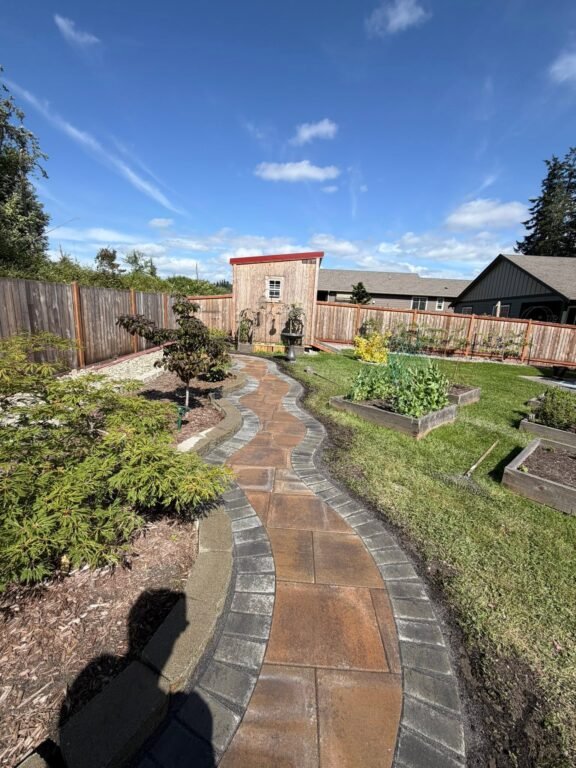
Pavers are the better fit if:
– You plan to stay in the home for 10 years or more
– Your yard has wet soil, clay, a slope, or large trees nearby
– You want a specific look, with color, pattern, or borders
– You want repairs to be simple and invisible
– You might add on later, since new pavers tie into old ones cleanly
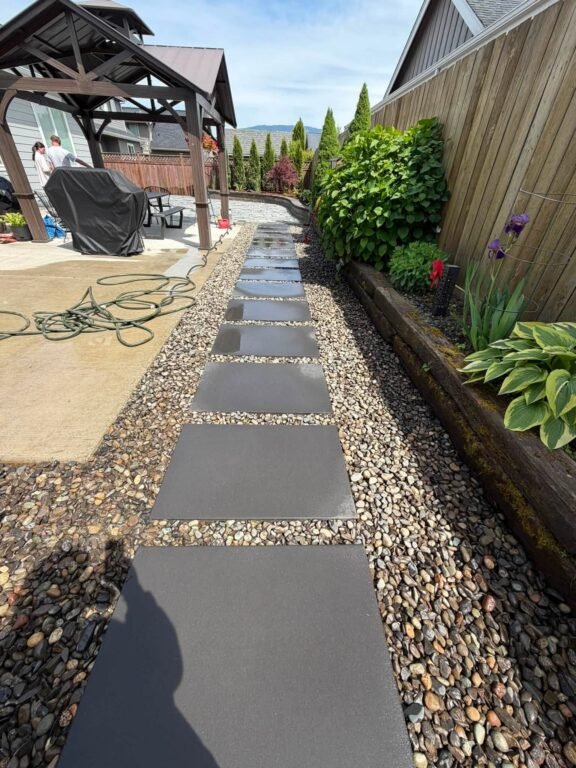
Concrete is the better fit if:
– Up-front budget is the main concern
– You need to cover a large, simple area such as a long driveway or a shop pad
– You prefer a clean, uniform surface
– The ground is stable and drains well
Common questions from homeowners
Are pavers cheaper than concrete?
No, not up front. Pavers usually cost more to install than plain concrete and about the same as stamped concrete. They tend to cost less over the life of the patio because repairs are small and full replacement is rare.
Do pavers last longer than concrete?
Yes, in most cases. A paver patio on a proper base lasts 30 to 50 years or more. Concrete typically lasts 25 to 30 years and usually shows cracks well before that.
Do weeds grow between pavers?
Weeds do not come up from below when the base is built correctly. Seeds can land in the joints from above, and polymeric sand keeps most of them from taking hold. Topping up the sand every few years handles the rest.
Will a concrete patio crack?
Eventually, yes. Control joints guide where it cracks and a good base slows it down, but all slabs crack with time, ground movement, and tree roots.
Which is better for a driveway?
Both work. Pavers handle vehicle weight well with a deeper base and are easy to repair. Concrete costs less for long driveways. Soil and budget usually decide it.
Are pavers slippery when wet?
Less than most smooth surfaces. The texture and joints give good grip in the rain. Keeping moss washed off matters more than the material.
Can you put pavers over an existing concrete slab?
Sometimes. The slab has to be sound, well drained, and low enough that the added height does not block doors or steps. A cracked or sunken slab should come out first.
Which adds more value to a home?
Pavers generally have more curb appeal and read as an upgrade to buyers. A clean concrete patio in good condition still adds value over bare ground or a worn-out deck.
Get a patio built to last
Not sure which surface suits your yard? We will look at your soil, drainage, and layout and give you a straight recommendation, even if that means a simpler option than you expected.
Brownstone L&H designs and installs paver patios, walkways, and driveways throughout Skagit, Snohomish, and Whatcom County. Contact us to schedule an on-site estimate.
Address
#BROWNL*753BW
Phone
360-333-7738
Brownstonelh@gmail.com